I am pleased to share that my article “A Brotherhood of Unequals: The Experience of Benelux Volunteers in the Waffen-SS’s Transnational Project” has been published in the Journal of Military History. The article presents research conducted as part of my Marie Skłodowska-Curie Fellowship at NIOD Institute for War, Holocaust and Genocide Studies.
Taking a comparative and transnational perspective, the article examines the experiences of foreign volunteers from Belgium, the Netherlands, and Luxembourg within the Waffen-SS. It explores the tensions between the organisation’s vision of a transnational, ideologically unified force and the realities experienced by Benelux volunteers. Although recruited as supposed “Germanic brothers,” these men encountered linguistic divisions, unequal opportunities, and marginalisation within military structures.
The article argues that the Waffen-SS’s pan-European project ultimately failed to overcome national identities or create genuine ideological unity. Instead, it produced a fractured and hierarchical military community in which belonging and equality remained conditional.
Nina Janz, “A Brotherhood of Unequals: The Experience of Benelux Volunteers in the Waffen-SS’s Transnational Project,” Journal of Military History 90, no. 2 (2026): 339–369.
Der Umgang mit gefallenen Wehrmachtssoldaten im Zweiten Weltkrieg – Zwischen persönlicher Trauer und politischer Instrumentalisierung
In this article for zeitgeschichte|online, I examine how fallen Wehrmacht soldiers were mourned and commemorated during the Second World War. I explore the tension between the private grief of families and the Nazi regime’s political instrumentalisation of soldiers’ deaths, focusing on death notifications, commemorative rituals, grave photographs, and the competing roles of the Nazi Party and the churches in shaping mourning and remembrance.
In this article for History Workshop, I explore how foreign war volunteers are buried and remembered, and what their graves reveal about belonging, loyalty, and national memory. Moving from the Spanish Civil War and the Second World War to foreign volunteers fighting in Ukraine today, I examine what happens when soldiers die fighting for a country that is not their own—and who ultimately claims and commemorates their dead.
In the aftermath of war, the dead are often left behind—not just as physical remains but as unresolved historical, ethical, and political questions. The legacy of World War II remains particularly contentious between Germany and Russia, as the memory of the war has shaped national identities, political relations, and reconciliation efforts for decades. Central to this negotiation of memory is the treatment of war graves and the recognition of the soldiers who perished—especially German soldiers buried in Soviet territory.
This essay is a summary of my lecture given at the University of Amsterdam, Regional, Transnational and European Studies on 13 February 2025. It examines the postwar reconciliation process between Germany and Russia, focusing on the practical and diplomatic efforts to manage war graves and the role of youth exchange programs in shaping historical understanding and reconciliation. These case studies provide insight into how former adversaries negotiate history, commemoration, and political narratives.
The German Memory Landscape: Commemoration and Controversy
Following the surrender of the German Wehrmacht in 1945, Germany faced a moral and practical challenge in addressing the fate of its fallen soldiers. Around five million German soldiers were killed or went missing during the war, leaving many families in uncertainty regarding their loved ones’ final resting places. Postwar commemoration was largely a private matter, as the burden of guilt and destruction overshadowed collective remembrance.
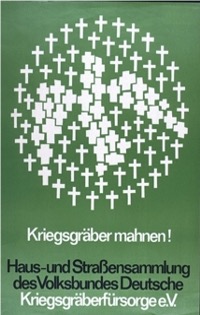
The Volksbund Deutsche Kriegsgräberfürsorge (VDK) emerged as a key organization responsible for managing German war graves, operating under the motto “Reconciliation over the graves.” The VDK maintained burial sites, provided families with information, and organized memorial events. However, its approach often leaned toward presenting German soldiers as victims of war rather than active participants in Nazi military aggression, a stance that sparked controversy, particularly after the 1985 Bitburg incident, where the presence of Waffen SS soldiers in a German cemetery reignited debates over Nazi commemoration.
In 1992, the German-Russian War Graves Agreement was ratified, ensuring legal protection for war graves in Russia and allowing for the maintenance and reburial of German soldiers. While this agreement paved the way for cooperative efforts, it also exposed enduring tensions, particularly in how both nations perceived and framed their historical narratives.
Soviet and Russian Memory Politics
For the Soviet Union, the Great Patriotic War (as WWII is commonly known in Russia) was foundational to national identity. With over 25 million dead, Soviet memory culture focused on heroism and sacrifice, leaving little room for acknowledging the losses of the enemy. Massive memorials, military parades, and Victory Day commemorations reinforced a national narrative of triumph and resilience.
During the Cold War, Soviet authorities restricted access to German war graves, claiming they no longer existed or refusing requests for visits. This began to change in the late 1970s when détente policies, including Willy Brandt’s Ostpolitik (1969–1974), opened limited pathways for engagement. Yet, the full-scale cooperation only materialized after the collapse of the Soviet Union in 1991, leading to the establishment of five major German war cemeteries in Russia.
Case Study 1: German Veterans and Local Responses to War Graves
A central element of German-Russian reconciliation efforts involved the exhumation and reburial of German soldiers, often accompanied by visits from German veterans and their families. These efforts, however, were met with mixed reactions from Russian communities.
While some Russian veterans and municipal leaders supported these efforts, others saw them as an insult to the memory of Soviet sacrifices. Newspapers often labeled German cemeteries as “fascist memorials,” and protests against their construction were common. In some regions, city councils blocked war cemetery projects, fearing backlash from local voters. In others, Germany facilitated infrastructure improvements—such as restoring roads and churches—in exchange for permission to construct cemeteries.
Although these visits fostered diplomatic goodwill, they did not necessarily lead to profound reconciliation. The commemorations remained formal and ceremonial, lacking critical engagement with the historical complexities of Nazi occupation and war crimes. The challenge in these reconciliation efforts lies in addressing the deeper questions of historical responsibility and memory without oversimplifying the past.
CASE Study 2: Youth Exchange and Reconciliation Programs
One of the most structured reconciliation efforts came through the VDK’s youth exchange programs, particularly the initiative “Work for Peace.” These programs, beginning in the 1950s, aimed to engage young Germans and Russians in joint efforts to maintain war graves while fostering dialogue and cultural exchange.
Originally launched in Belgium, these youth work camps expanded across Europe, eventually reaching Russia in the 1990s. By 2016, 42 such camps operated in 28 countries, involving nearly 1,500 participants annually.
While these programs allowed for hands-on engagement with history, they often lacked critical reflection on the ideological aspects of WWII. The focus on “peace and reconciliation” sometimes glossed over the realities of Nazi military aggression and Soviet repression. Russian participants often found it uncomfortable to work on graves of German POWs, as Soviet narratives historically depicted them as traitors. Moreover, discussions of Soviet wartime atrocities were largely absent from the program’s curriculum.
The Challenges of True Reconciliation
While the efforts of the VDK, German veterans, and youth exchanges have contributed to postwar dialogue, they fall short of achieving deep reconciliation due to several factors:
Both Germany and Russia have engaged in selective historical narratives. Germany has at times overemphasized its own suffering, while Russia continues to frame itself solely as a liberator, downplaying Soviet-era crimes. Unlike in France and Poland, where reconciliation developed organically through civil society initiatives, German-Russian reconciliation has been largely state-driven. This has limited the scope of societal healing at the local level. Russia’s use of WWII memory for geopolitical justification—especially in the current war in Ukraine—highlights how the past remains a political tool rather than a historical subject for open discussion.
Conclusion: Memory, Diplomacy, and the Path Forward
The reconciliation process between Germany and Russia over WWII war graves and memory remains a complex and unfinished project. The VDK’s war grave maintenance, veteran visits, and youth exchanges have laid the groundwork for dialogue, yet they remain largely symbolic rather than deeply transformative.
The core challenge remains: How can a nation commemorate its fallen soldiers without glorifying a military that served a genocidal regime? This question is especially pertinent in Russia, where memory politics continue to be contested and weaponized in contemporary conflicts.
Despite these challenges, one significant achievement stands out: Germany has successfully established permanent war cemeteries in Russia without major cases of vandalism or political annulment. This indicates a level of diplomatic success but also underscores the need for continued critical engagement with history. Moving forward, true reconciliation must involve deeper historical reflection, broader societal participation, and an honest reckoning with the past—beyond mere symbolic gestures. Only by acknowledging the full complexities of wartime history can Germany and Russia navigate the difficult terrain of memory politics and postwar reconciliation.
The content and research is based on following publications:
Chapter, “Arbeit für den Frieden” (Work for Peace), in Dissertation: Die deutschen Soldatengräber zwischen Heldenverherrlichung und Zeichen der Versöhnung Historische und kulturwissenschaftliche Fallstudien zum Kriegstod” (German Soldiers’ Graves between Glorification of Heroes and Sign of Reconciliation – Historical and Cultural Studies on War Deaths), University of Hamburg, 2019.
Nina Janz, War Grave Tourism in Russia, Tourism and Reconciliation, edited by Jan-Hinnerk Antons, 2025.
The current project WARLUX aims to study the biographies of young Luxembourgers, born between 1920 and 1927, who were drafted by the German Nazi authorities for Labour Service (Reichsarbeitsdienst) and the German Army (Wehrmacht). The conscription of young Luxembourgers is mostly displayed in documents, starting from police, enrolment registration records by regional authorities, lists of transportations and records about their service. However, for the study of biographies a more personal insight of the affected people is required, as behind these administrative files ley 10.000 other stories.
The focus of WARLUX is to analyse the evolution of experiences evoked by the World War II war from an actor-centred perspective and to re-evaluate the traditional categories of analysis by taking into account the multitude of war experiences and coping strategies of the people affected. The focus on the biographies will help to analyse the individual experience of the soldiers, recruits and women. In this regard, personal documents will constitute the core source for the overarching research question including enlistment records, personal files of the German armed forces and the RAD and ego-documents such as letters, diaries and autobiographies. Nevertheless, the project aims to collect personal insights, voices and individual impressions of the affected people. How to get an insight into the personal and individual view of our study objects? Their names are mostly known, in memorials, lists and literature. Between year numbers and historical frameworks, biographies consist out of much more, like the individual preferences, backgrounds, dislikes, characteristics, relationships to friends and family etc. This is not readable from state documents and from lists and passports from the military service. To analyse their view, we need to dive deeper into the analysis. What is left from their voices? Next to memoirs and oral history videos e.g. there are more sources to consider, the so-called “ego documents” such as diaries and letters. Letters are a unique source and provide more information about the individual fates as administrational documents.
If the letters is preserved it can give an interesting individual insight the momentum of the life of the affected people. The war was a major life notch in everybody’s lives in Europe. This crucial epoch changed the lives of the entire country and they being robbed of their the dreams and lives of the concerned people. The letters and other ego documents represent a cut in their lives, written from distant places, far away from home and the loved ones, desperate, sad and scared.
To keep the value in mind, what can these letters tell us, from an analytical and scientific point of view?
PROJECT WARLUX
The unique and new approach of temporal parallel spatial approach in looking into what happened in and outside of Luxembourg with this generation will draw a new detail in the history of World War II in this country.
WARLUX projects intend to draw another picture of these people and approaches the biographies from their individual perspective and fate. Out of the mass group of the 10.000, the projects intend to complement the pictures itself. Families and friends were separated. The connection to home was only possible via letters and parcels; a communication network of distribution news and greetings and signs of life. Nevertheless, the experiences distinguish from each other in a crucial way. While the families at home had to think about food, logistics, Nazi terror and switched into the survival mode; The young men and women abroad suffered from homesickness and fear and the hope for the war’s end. The letters represent a bridge to the homeland.
FIELD POST LETTERS AND OTHER LETTERS IN RESEARCH
The analysis of letters is different than memoirs or state, administrative documents. Letters express the momentum of the experience of the event, emotions and thoughts. Memoirs written years or decades after the war can represent a distorted image of the true events but letters can show only a short glimpse in the everyday life. One must also note that the content and the style of the document vary from its receiver. A mother received a sign of life from the son (everything alright, I have enough to eat and I am doing fine), while letters addressed to a friend might include another storytelling about front life. It should be taken into consideration which information wanted the writers to tell the others, what was essential to them and what has the other to know.
The war letters were written under abnormal conditions. Some things remained unspoken; some sender flippantly integrated the horror of everyday war life into their letters. The reality of war is therefore not always reflected in these type of documents. Field post letters differ clearly from ‘normal’ letters in peacetime. In the case of field post, transport times between 6 and 30 days can be assumed, provided that the shipment is not prevented at all due to a post block or loss. The conversation cannot take place immediately, but rather be “simulated in thought” by the writer, 30 and more than with correspondence in normal times, the transport route itself, the account of sending and receiving, will be the subject of the exchange. The time delay has the effect, especially in war with its rapid changes; a message can be out of date before it reaches the recipient. The awareness of this will influence the content of the letters.[1] Nevertheless, the field post provided a communication tool to stabilize personal relationships and to share news, emotions and experiences.
These documents play a crucial part in the research of individuals and their personal stories; although there are also limits to the analysis. Census banned the soldiers to reveal their position or to give details about combatants or units in case of an interception of the documents by the enemy. Next to official army regulations, the soldiers concealed facts or other traumatic events either to write the loved ones not to worry or because of the inability to express the horrors and the deaths they had to endure in battle.
Letters give there a filtered and chosen impression of the war experiences but are nevertheless valuable for the research about individual stories.
Collection Yves Rasqui, Pierre Britz (1922-1943), “Osten” (East), May 1943 to Mathilde Schmit, Ulflingen (Troisvierges)
LETTERS BY LUXEMBOURGERS – BETWEEN HOMESICKNESS AND THE WISH FOR CIGARETTES
Luxembourger conscripts were torn apart from their families during their labour and army service; they were torn away from their friends and social environment. Letters promised a way of communication.
The content, such as the quantity, depended on the person who wrote, where he or she was stationed and whom the letter was addressed. But every letter sender had one in common: Even at the front in Russia or Africa the young recruits remain sons and daughters, brothers and sisters. They shared their fears, their hopes for a soon war’s end or they wrote simply about daily events (marching, sleeping, details about food) and wishes and needs to receive warm clothes, groceries and cigarettes. Besides the interdiction of writing in other than German and the will of desertion, the recruits wrote personal wishes and thoughts home to escape as soon as possible this ludicrous situation in fighting in German uniform (only the mentioning of the wish to desert could have ended with severe consequences such as the execution).
The young men talked about contacts with locals in Russia and in Poland, fighting against Resistance (partisans), longing for intimacy with women, or friendship, postponing of hopes and wishes and future plans. Nevertheless, the letters provided the possibility to share thoughts and memories of better times, hopes and future plans and asking about the state of art in the Hemecht (home). Next to the situation at the front or in abroad labour service camps, the who stayed at home experienced as well difficult and frightening situations, such as intimidation by the national socialistic occupation authorities, air raids (from 1944 on), nutrition and in general the uncertainty as to how it will continue.
Collection Yves Rasqui, Pierre Britz (1922-1943), “Osten” (East), May 1943 to Mathilde Schmit, Ulflingen (Troisvierges)
Letter circles and pen friend networks were established to write the recruited to keep the link to home, to be not forgotten. Young women wrote regularly to their fellow Luxembourgers in many parts of Europe, to provide them with the daily news or to send writing material and cigarettes. For the called to arms, it meant comfort and support, even a word like Hello from the far home.
The two spaces, home and front, have to be taken into consideration to study the individual experiences and biographies of the who were born between 1920-1927 and their families.
Behind every letter lies another story, behind every story another fate.
Call for Contributions – Flyer, Warlux 2021
Call for Contribution
To extend the collection and to profit from these unique sources more documents are needed to conduct further research.
Therefor a Call for Contribution for the public is carried out by the team of WARLUX. People in Luxembourg Families and witnesses are called to share their memories and personal documents. WARLUX intends to find and identify personal documents, diaries, memories and photos which give an individual insight into their individual experiences and stories. Families and witnesses are asked to look into their cellars and attics, in old boxes and cupboards from grandparents and parents to find documents and photographs about this period of life.
The research team at the University of Luxembourg will (according to the agreement of the donors) scan it and store the documents properly. The families could send us the documents, or we can take from (with health measurements), we digitize the documents (with the approval of the families) and bring the originals back.
The letters and other ego documents will be used for qualitative data analysis to add and to study the individual experiences of the researched generation.
[1] Das Gesicht des Krieges. Feldpostbriefe von Wehrmachtssoldaten aus der Sowjetunion 1941-1944 (s. Anm. 2), S. 19.hu
To contribute and support the research of WARLUX
please contact the team via email, telephone and fax :
Martin Humburg, Das Gesicht des Krieges. Feldpostbriefe von Wehrmachtssoldaten aus der Sowjetunion 1941-1944, Opladen; Wiesbaden 1998.
Klaus Latzel, Kriegsbriefe und Kriegserfahrung: Wie können Feldpostbriefe zur erfahrungsgeschichtlichen Quelle werden?, in: Werkstatt Geschichte (22) 1999, p. 7–23.
Nico Everling, Liebe Jett. Feldpost eines Luxemburger Zwangsrekrutierten, Luxembourg 2003.
Katja Rausch, „Es geht alles vorüber, es geht alles vorbei…“ Philippe Gonners Briefe
von der Ostfront 1942-1944, Luxembourg 2003.
Veit Didczuneiet, Jens Ebert and Thomas Jander, Schreiben im Krieg. Schreiben vom Krieg. Feldpost im Zeitalter der Weltkriege, Essen 2011.
The documents from the Luxembourgish justice authorities, especially from the “cour d’assise”, tell stories about blood and thunder, murder and thieves, but also reveal stories about people, their personal histories, and their struggles in everyday life.
Image 1: Drawing – Act of crime ANLux CT1112 Jean Z. – Accused of attempted murder, 1903
One night in 1906 in the Grund of Luxembourg City, under the curved Bridge Adolphe, strollers made a terrible discovery: the body of a young man was found, without a head and badly battered. What starts like a thriller novel, is, in fact, true. This unknown episode in Luxembourgish history can be found in the files of the “cour d’assise”, held by the National Archives of the Grand-Duchy.[1]
The analysis and inventorization of these court records from 1900 until 1940 at the National Archives was part of the research project “HistJust” (Histoire de la Justice). The aim was to identify and to collect relevant documents for the ongoing research about law and order from 1815 until today. The court files mark only a small period of the work of legal institutions, but offers a unique contribution to further research in the field of history of justice.
The documents from the Luxembourgish justice authorities, especially from the “cour d’assise”, tell stories about blood and thunder, murder and thieves, but also reveal stories about people, their personal histories, and their struggles in everyday life. The records beat witness to the hopes and dreams of ordinary people living in the first half of the 20th century in the Grand Duchy.
The “cour d’assise” was established in 1810 as part of the French “Département des Forêts”. It was called into duty only for severe criminal cases, such as personal injury, rape, murder or theft. The judges of this court were appointed from 1831 on by the Supreme Court only for specific trials, which were held in the old Palace of Justice in the Rue Palais de Justice in the upper city of the Luxembourgish capital. The cases of the “cour d’assise” are well documented; the records from 1810 until 1940 are already inventoried, and are/will be accessible for further research.[2]
These historical documents cover the efforts of juridical authorities and include the detailed procedure from the police investigations, the indictment until the trial and the decision by the judges. The daily business of police, state attorney, defenders, judges and testimonies of the convicts highlight the functioning of the legal system and the application of the law in Luxembourg.
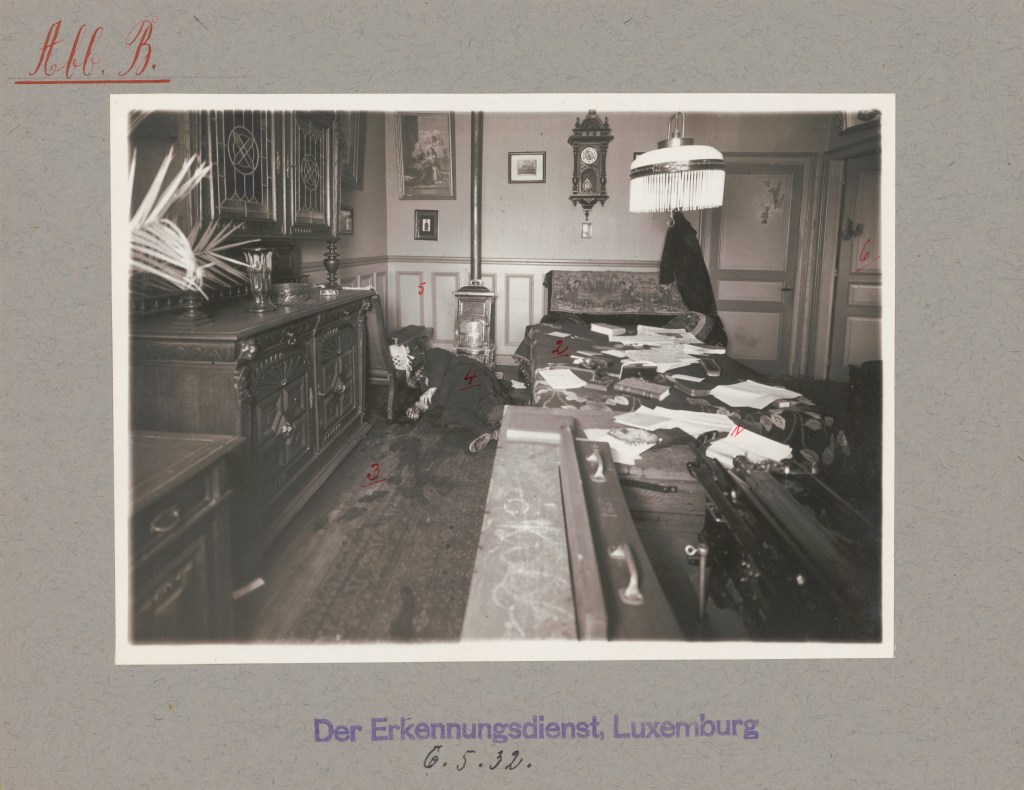
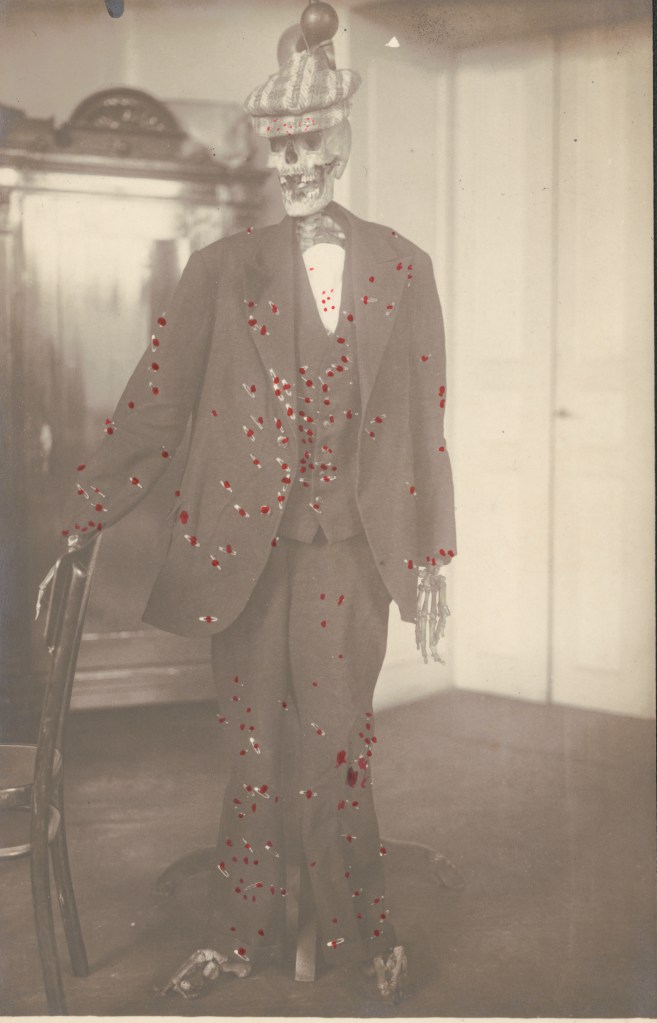
Image 2: Victim at the crime scene, 1932 ANLux CT 1435 Jovo M.; Georges C.- Accused of theft and murder, 1932-1942
After the discovery of the headless corpse in the Grund, the authorities launched an investigation. The possibilities and the investigation tools at that time were limited. The police ordered an autopsy for the body. But because the man did not have any documents on him and DNA-tests had not yet been invented, he remained unknown. Nobody seemed to miss him. Public announcements and messages were published in the newspapers; police and the prosecutors interrogated witnesses in the area of the Grund, the Petruss Valley, Hollerich and the train station area. The district was very disreputable during that time. Police assumed the victim might have visited prostitutes there and ‘sinned’. Investigations were held – without any results. The body remained unidentified throughout the entire investigation; some suspects were arrested, but soon rereleased. The headless corpse remained unknown so far. The police gave the victim the name Jean Pommerelle.
The documentation of the efforts of courts and police are preserved in the storages of the Nationale Archives at the Plateau of St. Esprit. The case of Jean Pommerelle includes two big archival boxes of records. Like the story of the murder of Pommerelle, other stories are waiting to be told. Stories about the abyss of the human soul, about the darkest chapter in Luxembourg’s history. Stories about quarrel, beatings, alcoholism, lost and forgotten individuals in the shady corners of the labourer districts and Gare quarter of the capital.
Women in trials
In the majority, more men were convicted of murder than women. However, women are represented in the documentation series of the “cour d’assise” not only as victims but also as suspects and convicts. They were sentenced for infanticide or for murdering their husbands or lovers. Nevertheless, infanticide remained the main accusation against women at the court. Over the decades, the cases repeat themselves: unmarried young girls, became unintentionally pregnant and killed (alone or with the help of others) the new-born shortly after the birth. The record contains cases of convicted women such as of Susanne, Elise and Catherine,[3] whom the judges brought into trial and punished by sending them to jail. The police reports contain personal and very intimate details about these girls and women; their way of life was investigated, who they loved, how they suffered. In case of a love affair outside the marriage, the woman was suspected of seducing the man and her becoming pregnant was perceived as her own fault. Being in this situation as a young girl, unmarried and uneducated or unemployed, the women did not see any chances in raising a child alone. They were dependent on men or their families, but they were expulsed or feared social exclusion. During the first half of the 20th Century Luxembourg was a strictly catholic and conservative country. Illegitimate children and sexual intercourse before or outside the marriage were deemed inappropriate. The concerned women feared the consequences of pregnancy or having a child alone, feared the disapproval of their own family, local society and the church and resorted the last desperate measure in killing the new-born. Abortion during this period was definitely illegal, even if the mother was in danger or the child was considered disabled, the termination of pregnancy was severely punished. A person (a doctor or midwife) who had performed the abortion could also have been convicted.
The stories of Susanne, Elise or Catherine do not differ significantly from each other. All women belonged to the working class and became pregnant through a love affair or even through rape. For economic reasons and social reasons, they killed their new-borns. The act is punishable under the Code Pénal and was negotiated by the “cour d’assise”. Despite the severe accusations (including murder), the young women were given a maximum of five years of prison as punishment.
In studying the judges’ decision over the decades, a researcher can observe various trends and developments in society and their interpretation of the law: abortion, for example, is no longer punishable (until the 12. week)[4] and the death penalty and forced labour have become final abolished. Women and men continue to be brought to justice and are punished by our current ethical and social understanding of law and order.
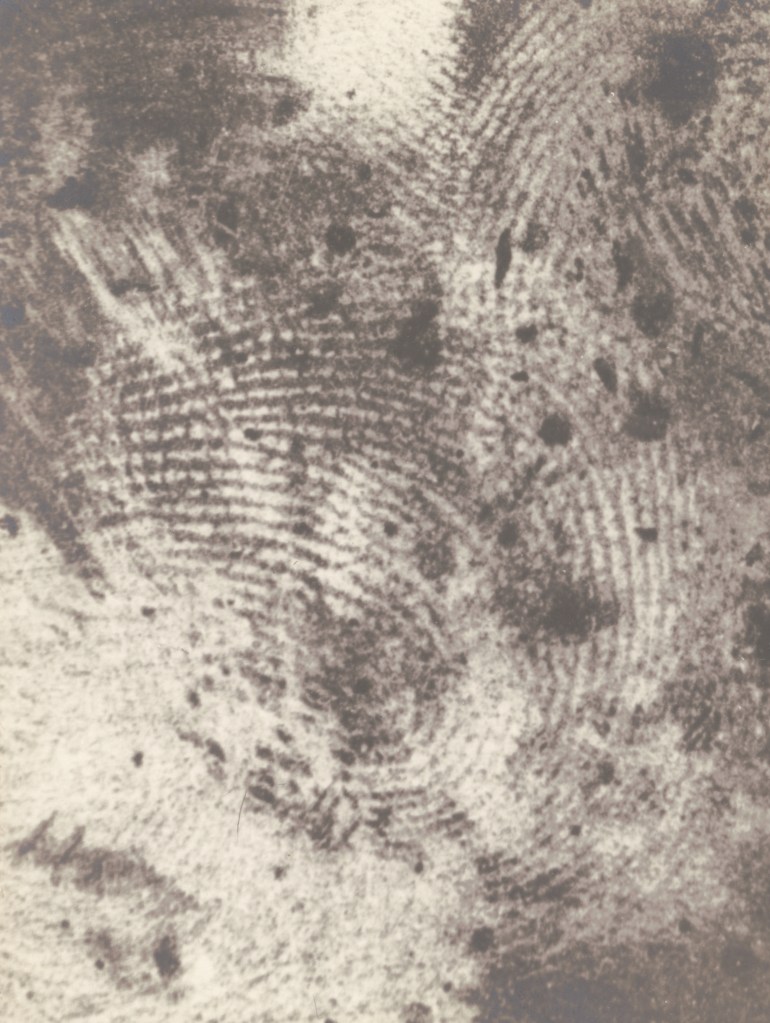
The court cases are a well-documented collection of evidence by the police. In addition to reports, testimonies and interviews, the files show initial attempts to use forensic methods like fingerprints or microscopic analyzes as well as medical and psychological reports. In this way, new evidence was used during the legal proceedings and the conviction of the suspects.
Modern Police Work
In the early 20th century, photography was not yet widespread, therefore the documentation of the crime was sketched, documented and written down. The sketch of a crime replicates the details and the sequence of the act. In 1903 attempted murder was captured precisely in drawings in order to reconstruct the crime scene and to use them during the trial (see image 2). This case refers to attempted murder after an argument about a stolen cabbage, and the responsible one was sentenced to 5 years in prison. The sketch supported the reconstruction of the crime for police, prosecution office and the court.[5]
Image 3: Fingerprints from the crime scene, 1932 ANLux CT 1435 Jovo M.; Georges C.- Accused of theft and murder, 1932-19428 – Main frame
Other methods of proving and documenting crime arose at the beginning of the 20th century, such as fingerprints, x-rays, detailed autopsy reports, the occurrence of ballistics report and photographs.
The new methods brought light to the procedure in Court, justice and police work. An example for these advances can be found within a story of robbery and murder: In April 1932 two men broke into an office to steal money in Limpertsberg. They killed a man and disappeared. The police were called and began their investigations. They took pictures of the crime scene (see image 2) and investigated the room for other traces such as the fingerprints (see image 3).[i][6]
Two men were arrested and questioned very soon after. They both denied the crime and blamed each other for killing the man. The fingerprints revealed the truth: one confessed the robbery and the murder finally, but regarded the second suspect as his accomplice in committing the crime.
The second man denied any participation in the killing and told the police he was innocent. The police investigated the clothes of the offenders for any possible traces. The clothes of the man who pleaded not guilty were also checked for bloodstains. The officers put the suspects’ clothes over a skeleton in order to re-enact how the victim died and where the blood splashes had come from (see image 4). Bloodstains on the clothes of the second suspect were found as well and proved that both men were involved in the crime (the murder). This story is just a short version of the thick court file but demonstrates pretty well the value of the storyline itself.
Image 4: Investigation of bloodstains on the suspect’ clothes, 1932 ANLux CT 1435 Jovo M.; Georges C.- Accused of theft and murder, 1932-1942
This whole source corpus promises new and unknown insights. The police reports document precisely the social life of victims, suspects and offenders, gives insights into the work of the legal authorities and offer a unique perspective on Luxembourgish history and the history of justice.
By the way, the real identity of Pommerelle was never been solved and his murderer remained unknown.
I want to thank the staff of the National Archives very much for their support and understanding of and for endlessly delivering and scanning files and patiently answering the many questions that I had.
Villmools Merci!
*Especially Faris, Patricia, Philippe Nilles and Corinne Schroeder!
[1] ANLux CT1157 Mathias F., Nicolas W., Théodore G., Michel F., Antoine T., Jean S., Josephe G. , Nicolas G., Guillaume S., Marie B., Jules F. – Accusés de meurtre / Suspectés de meurtre (1906-1930).
[3] ANLux CT1133 Susanne J. – Accusée d’infanticide (1904) ; CT1102 Elise B. – Accusé d’infanticide (1901) ; CT1395 Catherine S. – Accusée d’infanticide (1926-1958).
[4] Loi du 17 décembre 2014 portant modification 1) du Code pénal et 2) de la loi du 15 novembre 1978 relative à l’information sexuelle, à la prévention de l’avortement clandestin et à la réglementation de l’interruption volontaire de grossesse. (Mémorial A n° 238 de 2014).
[5] ANLux CT CT1112 Jean Joseph Z. – Accusé de tentative de meurtre (1909).
[6] ANLux CT1435 Jovo M.; Georges C. – Accusés de vol et de meurtre (1932-1942)
Soldiers and their communities in WWII: The impact and legacy of war experiences in Luxembourg – at C2DH, University of Luxembourg
More than 10,000 Luxembourgish soldiers and recruits and an unknown number of Luxembourgish men and women wore German uniforms during WWII in armed forces and civil organizations, such as the Wehrmacht, Waffen-SS, armed police forces and the Reichsarbeitsdienst (RAD). Who were these people? What was the reason for their commitment to the occupation forces? How did their families cope with the situation?
Being excited about the launch of the new project about Luxembourgish soldiers and (forced)recruited in RAD and Wehrmacht and working together with Prof. Dr. Denis Scuto and Michel R. Pauly as PhD candidate.
The Soviet war cemetery on Sinyavinsky Heights 3/3
The defense of the city of Leningrad and the fight against the German Wehrmacht cost millions of Soviet soldiers their lives.[i] During the war, the Red Army buried its soldiers in anti-tank ditches or in temporary graves; later, the graves were marked with a simple stake and a Red star, and the name of the fallen, if known. [ii] The German army held the Sinyavinsky Heights, north of the village Sinyavino, to block passage to the city of Leningrad. The Heights, surrounded by the river Neva, served as a strategic military vantage point for the Germans, which kept the Red Army from attacking. After several unsuccessful attempts to reach the Sinyavinsky Heights, the Soviets captured it in January 1944, during a bloody battle involving heavy losses.[iii]
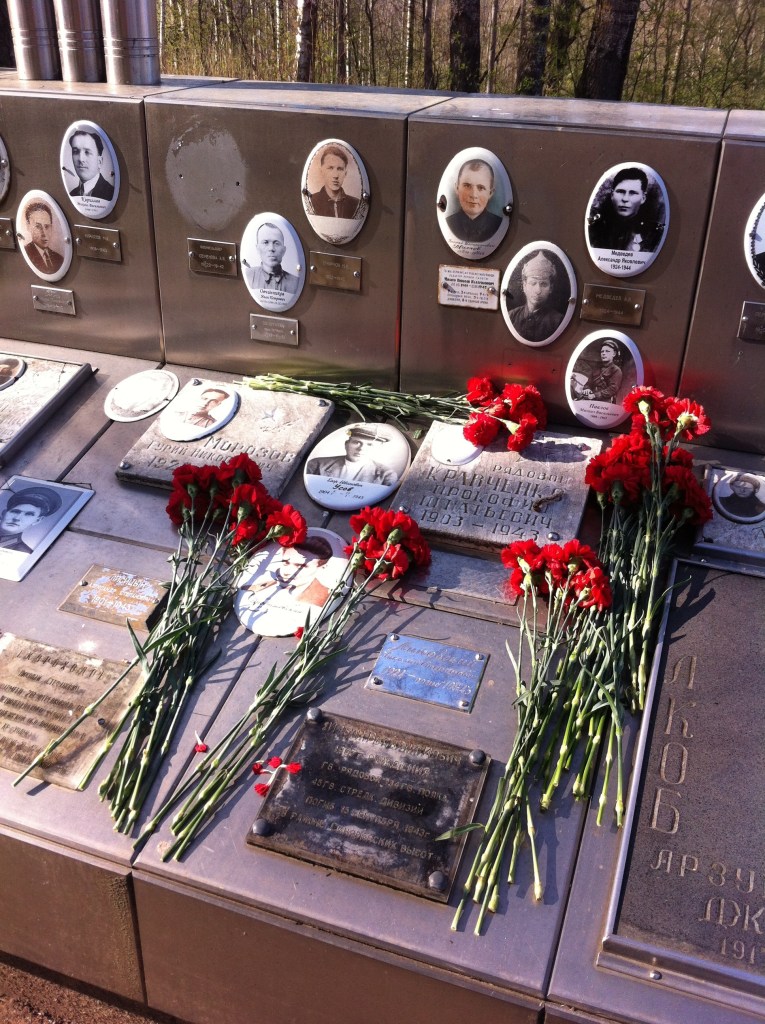
The Wall of Names, Sinyavinsky Heights, May 2016
After the Wehrmacht’s retreat from northwest Russia and the final Soviet victory in Berlin, the reconstruction process began in Leningrad and the surrounding Oblast region. The exact number of Soviet soldiers who died at the Leningrad front is unclear, but it has been confirmed to be over 1 million.[iv] The majority of the soldiers were buried in mass graves, either where they fell or close to the battlefields. ,The corpses were buried right on the battlefields of Sinyavinsky Heights, in mass graves. Until the late 1970s, the Heights remained a battlefield, with bullets and gas masks scattered around. The Oblast government then decided to remodel the battlefield into a memorial complex to mark the 40th anniversary of the Soviet victory.[v] The original plan was to turn the Sinyavinsky fields into a memorial park, including an open-air museum. The exhibition was intended to show the daily front life of the soldiers: the foxholes, shelters, outposts and weapons, such as tanks and rockets launchers. The open-air museum was never realized due a lack of funding, but the Sinyavinsky Heights were transformed into a memorial complex for “the defenders of the Motherland”. In this memorial complex, the visitor walks towards the main memorial via an Alley of the Heroes of the Soviet Union, a path with monuments and grave stones donated to heroes and veterans. In front of a mass grave stands a red granite obelisk with a Red Army star, marking the center of the complex. The obelisk holds the inscription “The fallen of the Soviet War, who fell in the Battle of Leningrad, on the Sinyavinsky Heights 1941-1944”. Two plaques are installed on the same obelisk, to remember two Heroes of the Soviet Union, Vladimir I. Ermak (1924-1943) and Stulan B. Baimagambetov (1920-1943), who are both buried in a mass grave within the complex. The remodeling of the Sinyavinsky Heights cost 2 million Russian rubles and was opened in 1985, for the 40th anniversary of the end of the Great Patriotic War.[vi]
The mass graves—in Russian “fraternal” or “comrade´s” graves—are scattered around the complex. Overall, there are more than twenty fraternal graves on the former battlefield. In many cases, it is unknown who is buried in these graves. Some graves have lists with names attached, or even individual plaques with names and photographs of the fallen sticking out of the graves. It is unknown whether family members knew exactly which graves their loved ones were buried in, or they just assumed. Even if soldiers could be identified, they are still buried in fraternal graves.[vii]
Over the next few years, some additional elements were included: the obelisk is now surrounded by steel walls, giving the memorial a more monumental and modern look; an eternal flame was also added; and some individual memorials for units and individuals were installed, such as the memorial for the 124th Red Infantry Division. The most remarkable elements of the Sinyavinsky Heights memorial complex are the wall of names and the wooden Russian Orthodox cross, which were not part of the original plan by the Oblast government. On the wall of names, relatives and families can install a plaque or picture of fallen or missing soldiers to remember them, even if they could not be found to be buried, or if the grave they are buried in remains unknown. Thus children and grandchildren have at least one place to remember their father or grandfather.
The orthodox cross was placed after the collapse of the Soviet Union, separate from the cemetery center, in-between the mass graves. It contains pictures of saints and the capital Cyrillic letters “Nika”, for Saint Nicholas, the patron of sailors, merchants and convicts, and one of the most popular saints in the Russian-Orthodox Church.[i]
The different elements of the complex – the obelisk, the eternal flame, the wall of names, and the mass graves – make the Sinyavinsky Heights a memorial site with many different layers. These represent the collective official narrative of the Soviet Union from within the obelisk, the personal grief and memory of the wall of names, to the religious mourning and commemoration of the fallen soldiers associated with the wooden cross and Saint Nicholas.
[i] Klaus Guth, “Nikolaus von Myra”, in Biographisch-Bibliographisches Kirchenlexikon, vol. VI (Nordhausen, 1993): 915-920.
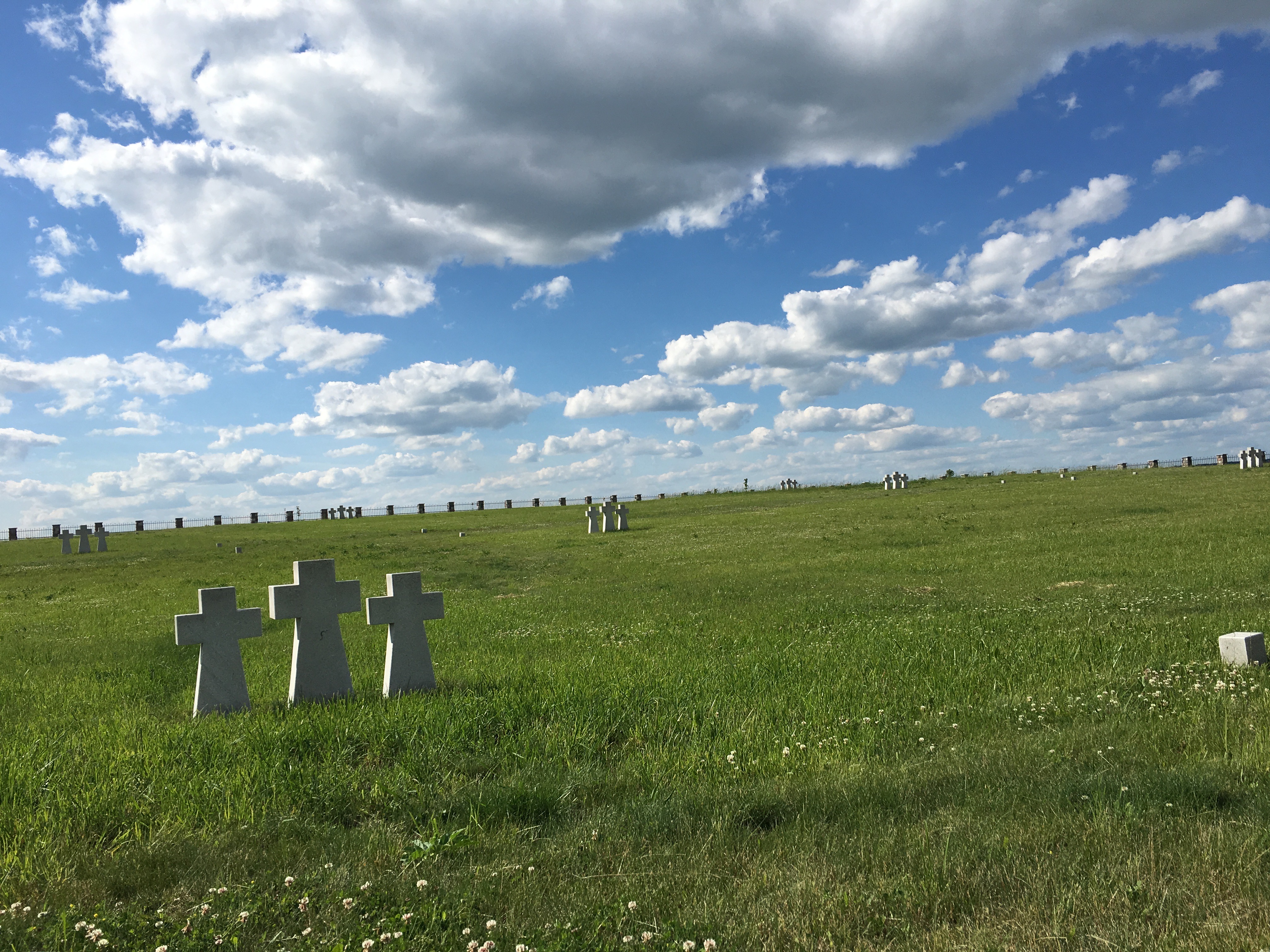
In the village of Sologubovka, beside the river Neva and the Soviet war cemetery on Sinyavinsky Heights, rest the German Wehrmacht soldiers that died during the siege of Leningrad, in the Second World War. [i] The old Russian Orthodox church in the village was used during the war by the Wehrmacht as a hospital; the fatalities were buried next to the church. During the war, the cemetery contained over 3,000 soldiers buried in individual graves with their names marked on crosses. By 1994, the names had been removed, and the graves were barely visible. After the German-Russian War Grave Agreement in 1992, the Volksbund, on behalf of the German federal government, began its search for the fallen and missing soldiers. The Volksbund started an investigation in the region around Leningrad to locate a suitable site for a larger cemetery. The village of Sologubovka offered enough space and proximity to transportation infrastructure for future visitors. The former German military cemetery in Sologubovka’s churchyard was used as the starting point for additional burials. A Russian architect, Alexander Kim, and the Volksbund redesigned this site, and began reburying exhumed Germans starting in1996. This project cost 1.9 million Deutsche Mark (DM).[ii] Today 54,247 German soldiers[iii] lie over 5 hectares of land in Sologubovka, in single graves, covered by a lawn and a few symbolic crosses. There is with space for 80,000 more remaining. A simple grey cross marks the center of the cemetery. Grey granite steles show the names of the buried soldiers, and stand on the main walkway beside the road.[iv] Even though every soldier is buried in an individual grave, the graves are not marked with individual crosses. Instead, the names of the buried are written on granite steles beside the walkway. The precise location of each grave is possible to find with a measuring tape (every corpse is buried approx. 50 cm from the next), and information provided by the Volksbund office. In some cases, private plaques, pictures or flowers from family members lie beside a soldier’s name or individual grave.
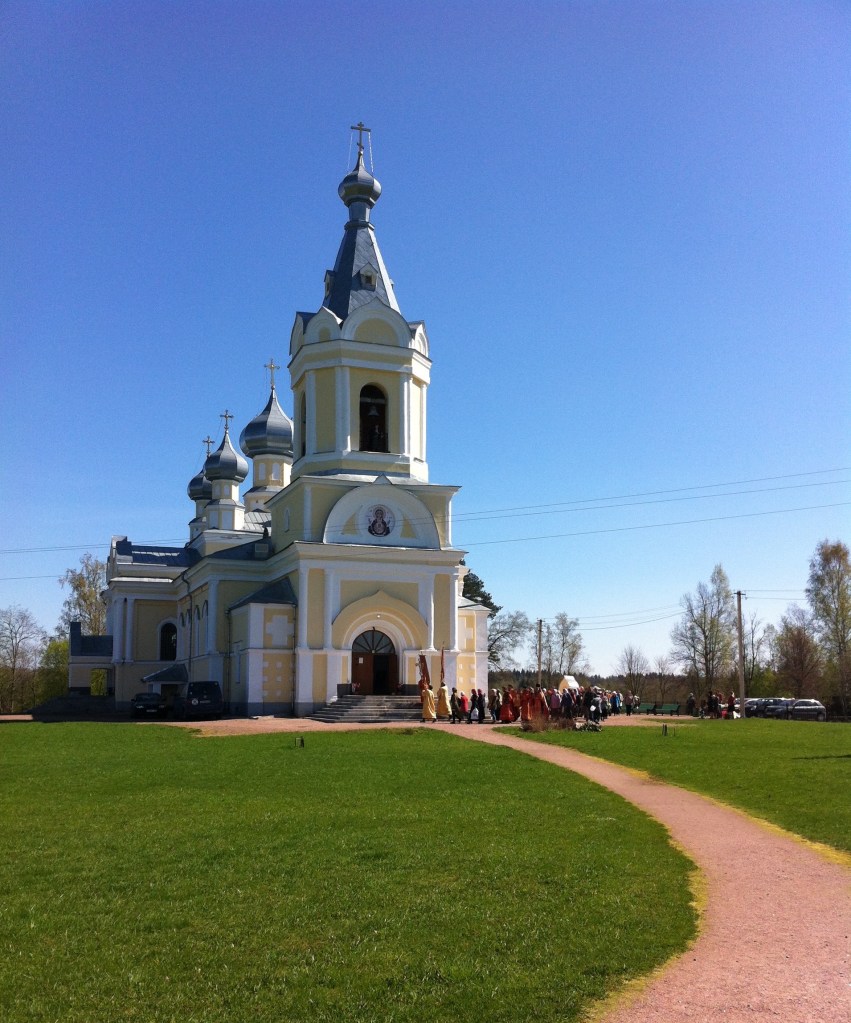
Orthodox Church Assumption of Mary
The cemetery is embedded into a whole unique memorial complex, which also contains a Peace Park and a Russian Orthodox church.[v] The Peace Park is connected to the cemetery, constructed with paths winding around trees and a watercourse. The highest, most dominant part of the memorial complex is the Russian Orthodox church, Assumption of Mary. The church was built in 1851, looted in the 1920s, and closed in 1937 after the priest was arrested and murdered by the Stalinist regime. During The Second World War, the German Wehrmacht occupied the little village of Sologubovka, used the church as a hospital, and buried their dead nearby. The church remained intact during the war; the Wehrmacht only removed the church’s tower because its height provided an easy target for the Soviet artillery.[vi]After the war, the church fell into disrepair and was used as a cinema and as a storehouse. The orthodox community continued to use the intact parts of the church for worship. In exchange for receiving territory in Sologubovka, the Volksbund agreed to rebuild the church. The Volksbund decided to include the church in the slogan “Reconciliation over the Graves”by renaming it the “Church of Reconciliation: Construction for the Future.”[vii] The Volksbund and donations financed the reconstruction. The complex was inaugurated in 2000, after almost five years,.
The combination of the cemetery and the orthodox church[viii] reinforces the message of the Peace Park. The whole complex was designed from a Christian perspective, particularly with the presence of the cemetery and church on the territory. The War Grave Agreement, the permission to build the war cemetery, and the close contact with the regional authorities made giving the soldiers of the Wehrmacht a resting place on Russian soil possible.[ix]
[i] In Russia, the Volksbund supervises today five large collective cemeteries in Russia, and since 1993 the staff has exhumed and reburied 380,000 dead. Sologubovka is one of five larger collective German war cemeteries in Russia, www.volksbund.de/kriegsgaeberstaetten (accessed 22 August 2016).
[ii] Volksbund Deutsche Kriegsgräberfürsorge e.V., Board Meeting, 20 November 1999, Volksbund Archives Kassel.
[iv] Steles were used instead of single gravestones due to the high number of losses and costs, Nils Köhler, “Der Volksbund Deutsche Kriegsgräberfürsorge e.V. Versöhnung über den Gräbern: Arbeit für den Frieden,” in Verständigung und Versöhnung nach dem “Zivilisationsbruch”? Deutschland in Europa nach 1945, ed. Corine Defrance et al. (Brussels, 2016), 431.
[vii] Volksbund Deutsche Kriegsgräberfürsorge e.V., Board Meeting, 20 November 1999, Volksbund Archives Kassel.
[viii] In the catacombs of the church an exhibition of the Volksbund shows the construction process of the cemetery, documents the blockade and the tragedy of Leningrad. The catacombs contain a room of remembrance for families of the soldiers, and books with names of all missing German soldiers on Russian territories.
[ix] The planning and constructing process was accompanied with difficulties and misunderstandings. For the case of Sologubovka and the memory practice of the Volksbund in Russia, see Nina Janz, Reconciliation over Graves? A German War Cemetery in Russia (online-publication by AIGCS/Johns Hopkins University, November 2016).
Impressions from a past research journey in 2016 and 2017
Fifty-six million people died during the Second World War; civilians, soldiers, and partisans. Every state and nation mourns and remembers their dead through monuments, remembrance days, authentic sites of memory, and cemeteries. Soldiers, as the largest group of the war dead, are glorified, victimized, or condemned. The cemeteries and mass graves that serve as their resting places reflect official national narratives of the Second World War.
During my research for my PhD thesis “German Soldiers Graves of WWII” I conducted material in the Leningrad area and visited memorial sites at the former battlefield. On these fields, both Soviet and Germans soldiers lost their lives and were buried in graves close to each other. These burial grounds represent opposing memories and disparate treatments of fallen Second World War soldiers. The landscape of Leningrad offers two perspectives and two blueprints of memory between victimhood and heroism, between grief and triumph.
GERMAN SOLDIERS GRAVES OF THE SECOND WORLD WAR BETWEEN HERO GLORIFICATION AND A SIGN OF RECONCILIATION – CULTURAL HISTORICAL CASE STUDIES ON THE DEVELOPMENT OF THE TREATMENT OF THE DEATH IN WAR
Ten cultural-historical case studies investigate how deaths in war were dealt with based on soldier graves of the Second World War. In this dissertation, the resting places of the fallen German soldiers offer a unique perspective in the evaluation of death during a violent conflict and in the post-war period. The examination frame extends from 1939 to the present and follows the reception and importance of the graves and the fallen in military, politics and society. Some single chapters of this thesis have been already published or are intended for publication. Methodologically, the study consists of empirical work, such as the analysis of unpublished archival sources, as well as hermeneutical tools in the form of interviews, surveys, local documentation, and field studies of burial sites and exhumations.
Two terms – hero glorification and signs of reconciliation – illustrate the differences in how the meaning of the graves and their dead soldiers was perceived. This difference highlights the change in values and meaning that the graves had to face.
In the Second World War, the Wehrmacht responded to the nearly five million German casualties with mythical hero stories, propaganda and parades, but also with an elaborate administration system and rules concerning the dead and their graves. The instructions for the soldier’s death included details about the material and inscription of the gravestone to the identification of unknown dead. The graves sustained a structure and organization in accordance with a modern military grave system. The claim to a single grave and the registration and notification of the relatives was included in the Wehrmacht. The denotation of the dead as heroes and their resting places as heroes’ graves (Heldengräber) and heroes’ groves (Heldenhaine) shows the attempt to integrate them into the ideology and propaganda of the National Socialist regime. However, the management of graves, as well as the cult of heroes, had to fail due to the reality of war – i.e., the number of casualties, the chaotic conditions at the front and the defeat of the Germans. The hero’s glorification could not be maintained after the end of the war.
In post-war society, an attempt was made to defuse the symbolism of military death and put it into a neutral and harmless context other than National Socialism. The continuation of the graves’ management, the search for unknown resting places and the construction of cemeteries could no longer be operated by the military. Under the slogan of reconciliation and the expression of peace and understanding instead, access to the Wehrmacht graves was reached first in Western Europe, after 1989 in Eastern Europe by the Volksbund Deutsche Kriegsgräberfürsorge e.V. The Volksbund builds and cares for cemeteries and exhumes the remains until the present. This effort is still being made by the Germans today and illustrates the importance of war graves care in modern international context. The studies show how mutable and dependent are the meaning and symbolism of the death of a soldier within different political and social constructs and epochs. In these studies, the range of soldiers’ graves as a research topic is clarified and further perspectives for questions and investigation contexts are shown. The investigation of German soldiers’ graves of the Second World War in terms of their relevance is of particular importance.
The fact that great efforts are still being made to find and maintain the resting places of dead soldiers more than 70 years after the war demonstrates the political dimension of the war dead and their graves. Above all, the distinctiveness of these objects as resting places for German soldiers makes an interesting and even controversial topic for science, politics and society not only in Germany but also in other European countries.
Russische und deutsche Jugendlichen reisen nun gemeinsam nach Ostwestfalen-Lippe
August 2016
Jugendliche aus Gütersloh und anderen Teilen Deutschlands reisten in das nordwestliche Russland, nach Rshew, um an einer deutsch-russischen Jugendbegegnung teilzunehmen.
In der im Zweiten Weltkrieg stark umkämpften russischen Stadt an der Wolga, wurden die deutschen Gäste herzlich von den russischen Teilnehmern traditionell mit Brot und Salz empfangen.
Das Camp findet bereits seit 20 Jahren regelmäßig in Rshew und seiner Partnerstadt Gütersloh in Deutschland statt und ermöglichte so bereits über 400 Jugendlichen aus beiden Städten einen Austausch zwischen den Kulturen.
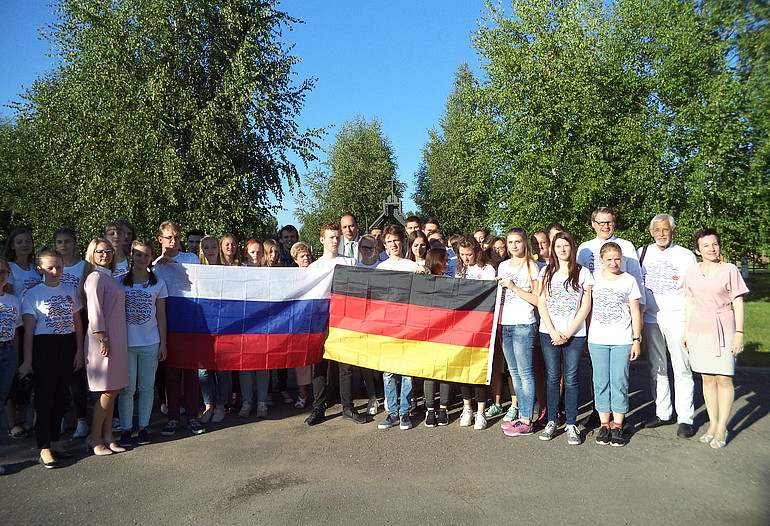
In Rshew arbeiteten die Jugendlichen auf dem sowjetischen und deutschen Soldatenfriedhof, dem sogenannten Friedenspark, besuchten Museen, Ausstellungen und Denkmäler und setzten sich so mit dem Zweiten Weltkrieg und seiner Gefallenen auseinander. Über den Gräbern von deutschen und sowjetischen Soldaten fand eine Annäherung zwischen den Teilnehmern statt, die sich auch mit den Einzelschicksalen im Weltkriege beschäftigten. Die Jugendlichen begingen nachdenklich die Trauerfeier auf beiden Friedhöfen und gedachten den Gefallenen beider Seiten. Ihre gemeinsame Freizeit an der Wolga verbrachten die Jugendlichen, im Alter von 15 und 22, bei Sport und Spielen, Singen und Lagerfeuer. Die russischen Gastgeber luden die deutschen Teilnehmer in die Familien nach Hause zum Essen und in die Banja ein. Neben gutem russischen Essen und köstlichen Wassermelonen, lernten sich die Teilnehmer aus beiden Ländern besser kennen, erhielten Einblicke in die russische Sprache, Kultur und Traditionen und setzten somit das seit zwei Jahrzehnten erfolgreiche deutsch-russische Programm fort.
Nach den gemeinsamen Tagen an der Wolga, geht es in die russische Metropole Moskau und von dort nach Gütersloh an der Dalke, wo die deutschen Jugendlichen ihre neuen russischen Freunde einladen werden, an der deutschen Kultur und Geschichte teilzunehmen. Von der Wolga, über die Moskva bis zur Dalke in Westfalen, alle Teilnehmer des 14. deutsch-russischen Workcamps bauen gemeinsam an der Brücke der Freundschaft und Versöhnung zwischen beiden Ländern.
What can the past tell us about the present and future? Nina Janz gives insights into her work as a Research Associate at the Centre for Contemporary and Digital History (C²DH) – interview with sience.lu (August 2019)
Nina, you are digging through the history of 200 years of legal system, court practice and of the ruling of law and order in Luxembourg. What did you discover?
In my everyday work I research and collect relevant documents at the Archives National, I prepare the findings for the digitalizing and a virtual exhibition. I am identifying and hunting for documents, which promise new insights into the history of Luxembourg. My research quest also brought me into different institutions, to collect relevant material, of which nobody knew they existed. The documents give various insights into legal history from the early 19th century to the 1980s. Between the pages of these records, I came across tragedies and personal stories of ordinary people convicted of theft or unusual cases of murder or abortion. These records demonstrate the development of the legal system in Luxembourg, from the application of the death penalty to a modern and liberal constitutional state.
Discovering these documents, I felt like a detective for history and older secrets.
Are these moments the reason you decided to pursue a career in history research in the first place?
Yes, definitely! Researching and academia give me the possibility to follow my interests in history and to find answers to the many questions I have. I am curious, and I love to discover new ways of thinking. In research, I can explore new pieces of the past and maybe write an entirely new story, like the so far undiscovered files. I find it fascinating to discover and report about the personal stories and the fate of these people to our society today.
What impact do you hope your research work can have?
History is an underestimated field, and many people think it is obsolete, that things are already over, the past is the past etc. However, the streets we walk in, the stones we step on have a story to tell! Luxembourg is a small country, but has a long and diverse history. Our job is it to tell these stories.
At the C²DH, my main goal is it to establish knowledge of the system of justice in humanities. My colleagues and I will show the accomplishments of democracy and an independent and fair court system in Luxembourg and the understanding of the long tradition of law and order in our western European world. We want to highlight the long and various history of different justice organisations, like the implementation of the code civil or the Cour d’assises in Luxembourg.
Secondly, in finding relevant documents and making them available for researchers and other interested people, I plan to develop strategies on access and inventorying the files and to develop workflows in digitizing historical documents.
Besides the discovery of juridical files, are there any other highlights in your research career you can tell us about?
Before coming to Luxembourg, I worked as an archivist at the German Federal Archive, in Koblenz and Berlin and at the Military Archive in Freiburg, where I managed requests and inquiries concerning the Wehrmacht, World War II and the fate of prisoners of war (POW) and other Nazi regime victims. I supported projects in digitalizing and preservation of documents and worked in a project of the German Historical Moscow to digitalize records of Soviet POW.
After my career at the archive, I obtained my doctorate at the University of Hamburg in cultural anthropology about the impact of death and violence and the memory of World War II in the post-war period in Germany and Russia. Based on soldier graves I investigated the value of the war death in the past and the current society. My research brought me to two different continents, to Eurasia (Russia) and America (USA). I have gotten the possibility to undertake large field trips through Russia. I travelled from St. Petersburg via Moscow, to the river Don and then to West Siberia. The people I met, the information I could collect for my thesis, and of course the wide and beautiful landscape of Russia impressed me!
Why did you decide to continue your research in Luxembourg?
The University of Luxembourg is still a young university and the academic tradition still an almost blank sheet. New projects, new ways of thinking are possible. You can experiment with new approaches, or like our Centre the C2DH, you can dive into digital history and combine traditional research with technology.
Because of its small size, the ways in the bureaucracy are shorter, ways of communication are easier than in bigger countries like in Germany. You can reach people, even ministers and the attorney general themselves, and discuss your research results or get insights into their work.
How is working as a Postdoc different for you than being a PhD student?
Working as a postdoc comes with more freedom and independence. The project is more extensive, and I am working in a team, which makes it not as lonely as the dissertation. I cooperate with two other researchers; we need to coordinate and to discuss our procedure and the results. I do not feel like a lone fighter anymore, and I enjoy the discussions and stimulating conversations. With multiple heads and brains, we can achieve more than a single researcher – and the output of our project will be more diverse and creative.
Thank you very much for these insights into your work.
Questions and revision: Emily Iversen (FNR) and Michelle Schaltz (FNR)
Methodenseminar mit Volksbund-Beteiligung in Kursk
28. April 2016
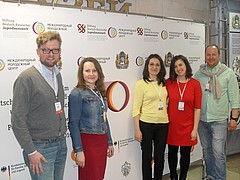
Foto: Marina Ignatova, v.l.n.r. Jörg Schgalin (Volksbund Deutsche Kriegsgräberfürsorge e.V.), Marina Ignatova (Südwestliche Staatliche Universität Kursk), Julia Makarova (Zentrum für Patriotismus und Kriegsgräbersuche Wolgograd), na Janz (Volksbund), Michael Schukov (Jugendagentur „Interaktiv“ Jaroslawl)
Vom 17. bis 22. April 2016 trafen sich etwa 50 Vertreter von Schulen, Jugendorganisationen und weiteren Bildungseinrichtungen aus Deutschland und Russland in der südwestlich von Moskau gelegenen Stadt Kursk. Die Veranstaltung fand unter dem Motto „70 Jahre nach Ende des Zweiten Weltkrieges: Jugendaustausch, Verständigung, gemeinsame Zukunft“ statt. Der Ort Kursk wurde von der Stiftung Deutsch-Russischer Jugendaustausch und dem Russischen Nationalen Koordinierungsbüro für den Jugendaustausch mit Deutschland (Международный молодёжный центр) bewusst gewählt: Hier fand im Sommer 1943 eine große Panzerschlacht statt; dabei verloren etwa 100.000 Soldaten auf deutscher und sowjetischer Seite ihr Leben. Vom Kriegsgeschehen in und um Kursk zeugen heute zahlreiche Panzergräben, Denkmäler, Museen und vor allem Friedhöfe für die gefallenen Soldaten.
Erinnerungskulturen im Vergleich
Erklärtes Ziel aller Teilnehmenden, darunter Nina Janz (Teamerin) und Jörg Schgalin (Bildungsreferent im Kompetenzcenter Internationale Jugendbegegnungen) vom Volksbund, war es, sich mit dem Schlachtfeld Kursk als Erinnerungsort gegen Krieg und Gewaltherrschaft vertraut zu machen und sich auch über Methoden der Vermittlung, des historisch-politischen Lernens auszutauschen. Deshalb stand im ersten Teil des Seminars die Beschäftigung mit den kollektiven Erinnerungsleistungen Russlands und Deutschlands an den Großen Vaterländischen Krieg bzw. den Zweiten Weltkrieg an. Exkursionen zu russischen und deutschen Erinnerungsorten in und um Kursk, z.B. das Historische Museum in Ponyri oder die deutsche Kriegsgräberstätte Kursk-Besedino, halfen den Seminaristen, die Erinnerungskulturen beider Länder besser kennen zu lernen.
Exkurs: Die deutsche Kriegsgräberstätte Kursk-Besedino
Die deutsche Kriegsgräberstätte Kursk-Besedino ist ein Friedhof des Volksbundes, der Platz für bis zu 50.000 Gefallene und in Kriegsgefangenschaft verstorbene deutsche Soldaten des Zweiten Weltkrieges aus den Gebieten Kursk, Orel, Woronesch, Tula und Belgorod bietet. Der Bau des Friedhofs Besedino wurde im Jahr 2006 begonnen. Im Oktober 2009 erfolgte die Einweihung. Noch immer finden Zubettungen statt. Auf der Kriegsgräberstätte fanden von 2007 bis 2012 Pflegeeinsätze durch Jugendliche im Rahmen von Volksbund-Workcamps statt. Besedino reiht sich damit als ein wichtiger Lernort in die Erinnerungslandschaft des Zweiten Weltkrieges in Osteuropa ein.Mehr Informationen zum Friedhof
Pädagogische Herausforderungen in Jugendbegegnungen
Im weiteren Seminarverlauf tauschten sich die Teilnehmenden auch über pädagogische Herausforderungen aus, denen 2-nationale Veranstaltungen mit einem inhaltlich-thematischen Bezug zum Zweiten Weltkrieg unterworfen sind. Festgestellt wurde u.a., dass der Begriff „Held“ unterschiedlich konnotiert ist. Während in Russland ein positives Bild, z.B. vom heldenhaft-agierenden Soldaten der Roten Armee existiert, ist der Terminus auf deutscher Seite, bedingt durch das Wissen um die nationalsozialistischen Verbrechen, negativ aufgeladen. Diesen Unterschied in einer Jugendbegegnung aufzugreifen, ist eine Notwendigkeit und zugleich eine große Chance der historisch-politischen Bildungsarbeit im deutsch-russischen Jugendaustausch.
Welche Erfahrungen und welche Methoden in der Friedenspädagogik existieren, dass konnten die Teilnehmenden eigenständig und in moderierter Form während des 4-tägigen Aufenthaltes in Kursk bestens erfahren. So stellten sich die Teilnehmenden persönliche, familiäre Erinnerungsgegenstände, z.B. Fotos, Urkunden und weitere Dokumente aus der Zeit des Zweiten Weltkrieges gegenseitig vor. Eine abschließend-moderierte Reflektion sensibilisierte alle Teilnehmenden für Chancen und Grenzen dieser Methode. Beispielsweise kann diese beim Vorstellenden aber auch Zuhörenden eine starke Emotion hervorrufen, die folglich eine Beruhigung des Betreffenden durch den Moderatoren und / oder die Gruppe bedingt.
Plattform für zukünftig Projektpartner
Das Seminar diente nicht nur dem Methodentraining sondern auch der Netzwerkarbeit und der Initiierung zukünftiger Austauschprogramme und Projekte. Die Vertreter des Volksbundes konnten sich dabei mit ihren Projektpartnern, wie z.B. mit Michail Schukov von der Jugendagentur „Interaktiv“ aus Jaroslawl (Jugendbegegnung Jaroslawl-Potsdam 2016), austauschen und weitere russische Bildungseinrichtungen für den zukünftigen Jugendaustausch an den Standorten Kursk und Wolgograd interessieren.
Exkurs: „Looking for history – Geschichte(n) gesucht!“
„Looking for history – Geschichte(n) gesucht!“ so lautet der Titel dieser deutsch-russischen Jugendbegegnung, die in Jaroslavl beginnend über Moskau sowie Berlin führend nach Potsdam kommen wird. Der Volksbund und die russische Partnerorganisation Interaktiv aus Jaroslavl laden interessierte Jugendliche im Alter von 16 bis 24 Jahren zu dieser Reise ein. Gemeinsam möchten die Teilnehmenden der Frage nachgehen: Welche Bedeutung hat Geschichte, insbesondere die des Zweiten Weltkriegs / des Großen Vaterländischen Krieges, für mich? Die Veranstaltung findet im Zeitraum 17. bis 31. Juli 2016 statt. Weitere Informationen zur Begegnung
Trotz des aktuell-angespannten deutsch-russischen Verhältnisses auf politischer Ebene, gilt es, den grenzüberschreitenden Dialog, den Jugendaustausch mit Russland als aktive Form der Verständigungs- und Friedensarbeit aufrecht zu erhalten und, wenn möglich, mit weiteren Projekten zu verstärken. Das Methodenseminar in Kursk ermutigte alle Akteure dazu. Wir bedanken uns recht herzlich bei den Veranstaltern!
Eine russische Version diese Artikels finden Sie hier.